Baley’s accusations and confrontation in Spacetown
The Caves of SteelBaley’s accusations and confrontation in Spacetown mark the moment his investigation shifts from trying to identify a killer to disputing whether Dr. Sarton was killed at all. Before Dr. Fastolfe, R. Daneel, and Commissioner Julius Enderby, Baley announces that there was no murder and points to R. Daneel as the person he believes is Dr. Sarton. He then accuses Spacetown of staging the case to foment riots and invite intervention from the Outer Worlds. The exchange makes a bold theory public, but its momentum is checked when Fastolfe demonstrates that R. Daneel is a robot.
Political Stakes and Jurisdiction
The confrontation grows out of an investigation already caught between local authority and interplanetary pressure. Enderby tells Baley that he has spent three days in conferences with the Mayor, at Spacetown, and in Washington with the Terrestrial Bureau of Investigation. The bureau regards the case as New York’s responsibility because Spacetown lies within the city limits, although Spacetown has extraterritorial rights. The competing claims mean that formal jurisdiction does not settle who can investigate or what consequences an investigation can impose.
Enderby explains why the case threatens to exceed ordinary police work. The Spacers can insist on conducting their own investigation and can report their findings to their home governments. The Outer Worlds might use the killing as grounds for indemnity charges: agreeing to pay could be political suicide for the White House, while refusing could bring another kind of political disaster. In this setting, the investigation is not only a search for the truth; it is also a contest over which government will define the event and bear its costs.
Baley Announces His Conclusion
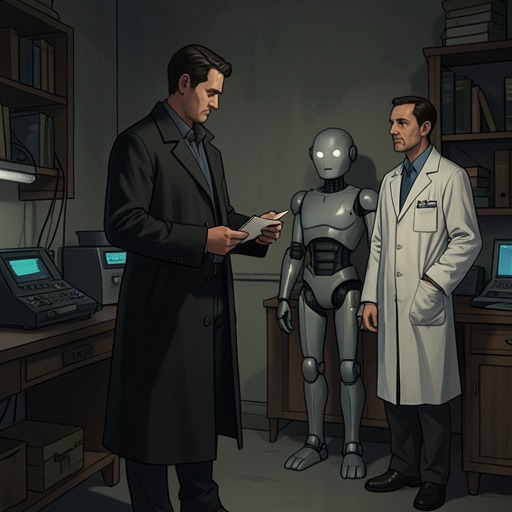
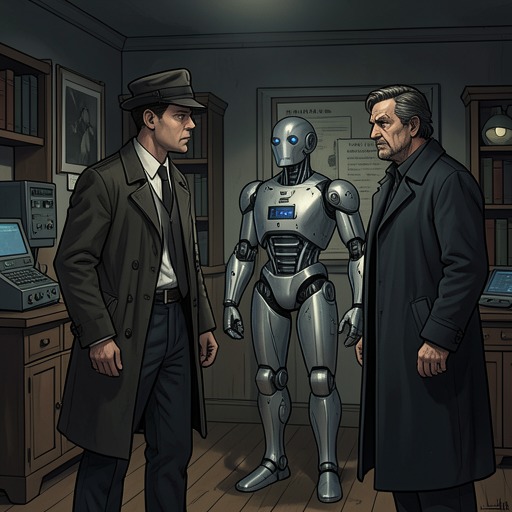
After securing a witness through the trimensic connection to Enderby, Baley says he has penetrated the mystery surrounding Dr. Sarton’s death. Fastolfe asks whether he knows the murderer. Baley instead replies that there was no murder. He then answers Fastolfe’s question about whether Sarton is alive by pointing directly at R. Daneel, claiming that the figure presented as a robot is Dr. Sarton.
The accusation unsettles the people in the room in different ways. Enderby rises abruptly and has to sit back down after his movement carries him outside the trimensic receiver’s limits. Fastolfe is also startled, while R. Daneel remains unmoved. Baley’s declaration thus turns a private deduction into a claim made before both the Spacer scientist and the Earth commissioner, with Enderby present as the witness Baley believes his argument needs.
The Conspiracy Theory
Baley’s explanation depends on reading the apparent murder and the investigation that followed as parts of one design. He argues that the supposed corpse was disposed of, leaving it unavailable for close examination. He also challenges the claim that an Earthman committed the killing: to make that accusation fit, the Spacers would have to suppose that a City man left the City alone at night and crossed the countryside to reach Spacetown.
He links that doubtful accusation to the arrival of the supposed robot in the City. In Baley’s account, the robot threatens a human crowd with a blaster, while the rumor that a Spacer robot is working with the police spreads beyond the immediate incident. Jessie has told him that the robot’s police connection is already known. Baley warns that the story could travel through the yeast-vat country and down the Long Island hydroponic plants, transforming a disputed case into a wider fear of a killer robot.
From those circumstances, Baley concludes that a conspiracy exists in the City but is being run from Spacetown. He alleges that the Spacers want a reported murder, riots, and an assault on Spacetown; escalating disorder, in his theory, would provide the incident needed for Spacer ships to occupy Earth’s cities. Fastolfe responds that the Spacers already had an excuse in the Barrier Riots twenty-five years earlier. The exchange establishes the invasion theory as Baley’s accusation, not as a proven account of Spacer policy.
Fastolfe’s Challenge and the Physical Test
Fastolfe does not accept Baley’s conclusion as established. He points out a difficulty in the accusation: if R. Daneel is actually a robot, the body Enderby saw could have been Dr. Sarton’s, rather than another robot fabricated to resemble him. Enderby had witnessed R. Daneel under construction and could confirm that only one such robot existed. Baley counters that Enderby is not a robotics expert and might not know whether more than one had been made, but this does not resolve the question of what R. Daneel is.
When Baley observes that he could not have tested the supposed robot with instruments such as a hypodermic, stethoscope, or microscope without its cooperation, Fastolfe turns the challenge into a direct demonstration. R. Daneel opens the seam of his right sleeve, revealing a limb that appears human, including short bronze hairs. He then separates the arm’s outer covering. Beneath a thin flesh-like layer, Baley sees stainless-steel rods, cords, and joints. The physical evidence confirms that R. Daneel is a robot, undermining the premise that he is the living Dr. Sarton and forcing Baley’s theory to confront a fact visible in the room.
Evidence, Law, and the Limits of the Accusation
The confrontation’s stakes extend beyond what the participants can see. Baley later recognizes a difficulty in relying on R. Daneel as a witness: a robot has no status in an Earth court of law. Even a claim that R. Daneel can remember faces among a million people would not make his testimony useful to a court, Baley argues, because his identity as a robot disqualifies him. Thus the same being who can supply extraordinary information may be legally unable to establish it as evidence.
The episode leaves Baley’s grand accusation unresolved in the evidence presented here. Fastolfe’s demonstration settles R. Daneel’s mechanical identity, but it does not, by itself, explain the apparent corpse, prove who caused Dr. Sarton’s death, or establish Baley’s claim that Spacetown intended to provoke an occupation. The confrontation is decisive less as a completed solution than as a collision between inference and demonstration: Baley makes the political pattern legible, while Fastolfe exposes a vulnerable assumption at its center. It also shows how the case’s truth is constrained by the institutions that must recognize it, from competing jurisdictions to a court that will not accept a robot as a witness.